Chapter 4 / 6 parts
Social Production Connects to the Third Curve
AI compounding spills from model labs into software, science, manufacturing, organizations, and governance.
Chapter 4
The Third Paradigm of Compound Growth: Chapter 4
If the previous chapter examined how intelligence can produce intelligence, this chapter pushes the view outward. AI compounding will not remain inside AI labs. Once intelligent capability can be called, copied, deployed, and embedded in workflows, it will enter science, software, manufacturing, education, finance, medicine, media, organizational management, and public governance. The third curve changes the speed of the model industry, but it also lets social production connect to an external intelligent infrastructure that can thicken over time. Earlier general-purpose technologies also spilled outward. Electricity entered factories, computers entered offices, and the internet entered commerce and communication. AI's spillover is different because it exports callable cognitive labor: code, retrieval, planning, evaluation, simulation, coordination, and in some domains task execution.
This changes the form of social compounding. Capital compounding depends on returns being reinvested. Skill compounding depends on human experience accumulating. Technology diffusion depends on tool adoption and organizational adaptation. With AI, social production gains another accumulation mechanism: the improvement of intelligent systems is embedded into more production links; the data, feedback, tasks, and evaluations produced by those links can in turn modify intelligent systems. The use of AI by society may gradually become the act of placing more production activity inside an intelligent loop that thickens itself. The key is not a single job being replaced. The key is that production activity begins to leave machine-readable, feedback-rich, evaluable, reusable traces.
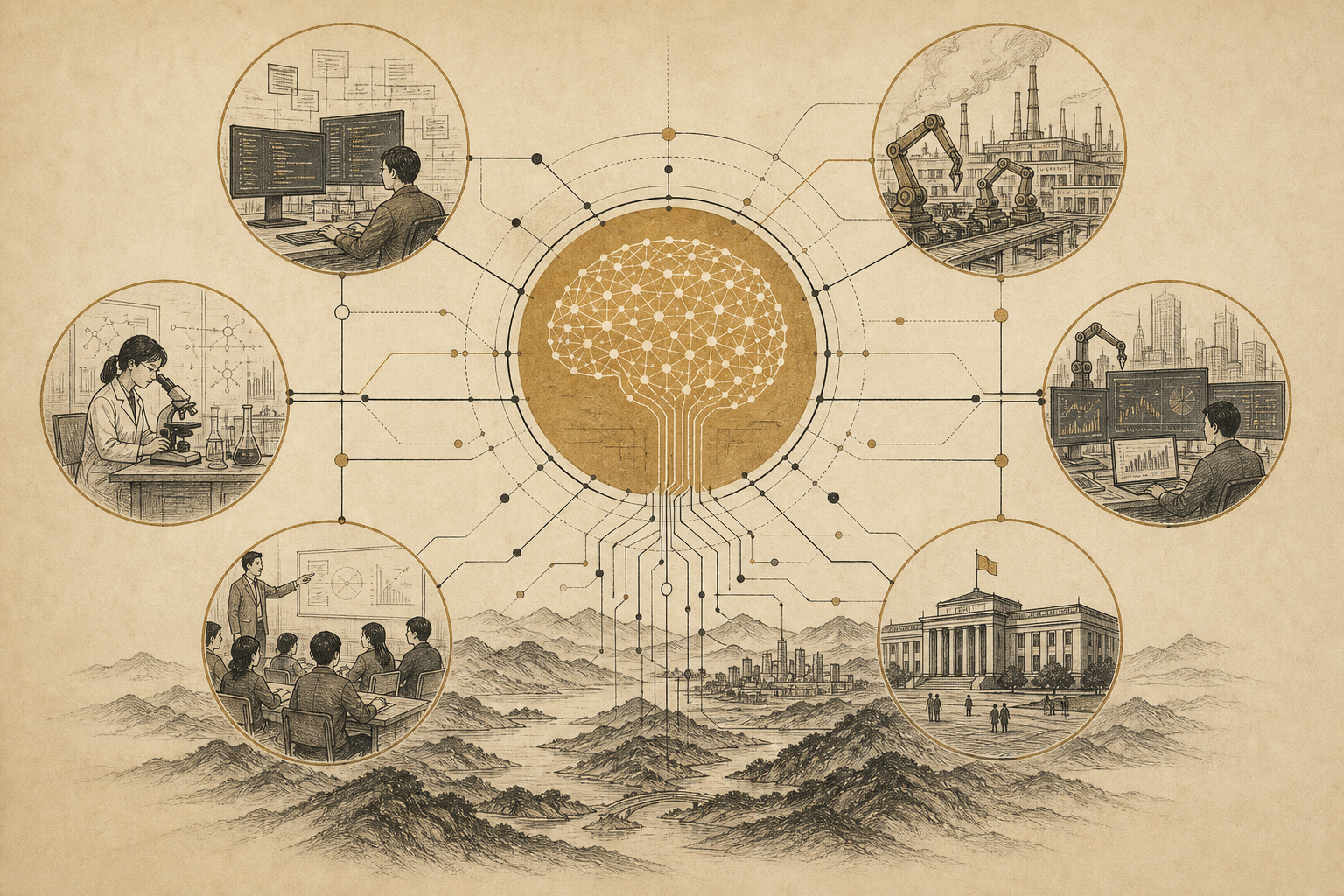
Software will feel this first because code, tests, deployment, documentation, debugging, and review already live in digital environments. A stronger model can help write more code, but it can also improve developer tools, generate tests, locate faults, maintain dependencies, and refactor systems. Faster software production then improves the information systems of nearly every industry. The compounding here is not only that one programmer saves hours; it is that the iteration speed of software as social infrastructure may rise. If software updates faster, enterprise workflows, scientific tools, education platforms, manufacturing systems, and financial infrastructure all gain a faster capacity for redesign. Software is already the nervous system of modern organization. AI strengthens that nervous system's ability to update itself.
Science follows a similar logic. AI can read literature, form hypotheses, design experiments, analyze data, run simulations, search materials, and assist drug discovery. It does not need to replace scientists in one step. If it compresses parts of the research workflow, the time scale of knowledge production changes. Scientific discovery still needs contact with the factual world, but the speed of generating and filtering candidate paths can change sharply. In materials, drugs, proteins, chips, climate simulation, and other search-heavy domains, AI may most powerfully increase the number of promising paths that can be tried.
Education and skill formation will also connect to the curve. Traditional education compounds mostly inside the learner: long training gradually builds understanding, judgment, and expression. With AI, the learning process can produce denser data: where a student gets stuck, which explanation works, which exercise transfers, and which mistake repeats. A good intelligent tutor does not only teach one person; it can learn from many learning processes and improve future teaching. Skill still compounds inside people, but the environment that produces skill begins to connect to external intelligent compounding.
Manufacturing and energy bring the curve into the physical world. Compute clusters need chips, data centers, power, cooling, networks, and capital. Robotics, automated factories, and digital twins push intelligent capability further into physical production. The physical world will not replicate like software. Steel, land, grids, supply chains, regulation, and safety impose hard constraints. Precisely because those constraints exist, trillion-dollar clusters matter: they show that intelligent compounding is not a purely virtual phenomenon, but a new industrial mobilization of capital, energy, chips, and state capacity. If intelligent systems help design chips, optimize grids, improve robots, and coordinate supply chains, they also begin to modify the physical infrastructure that supports their own expansion.
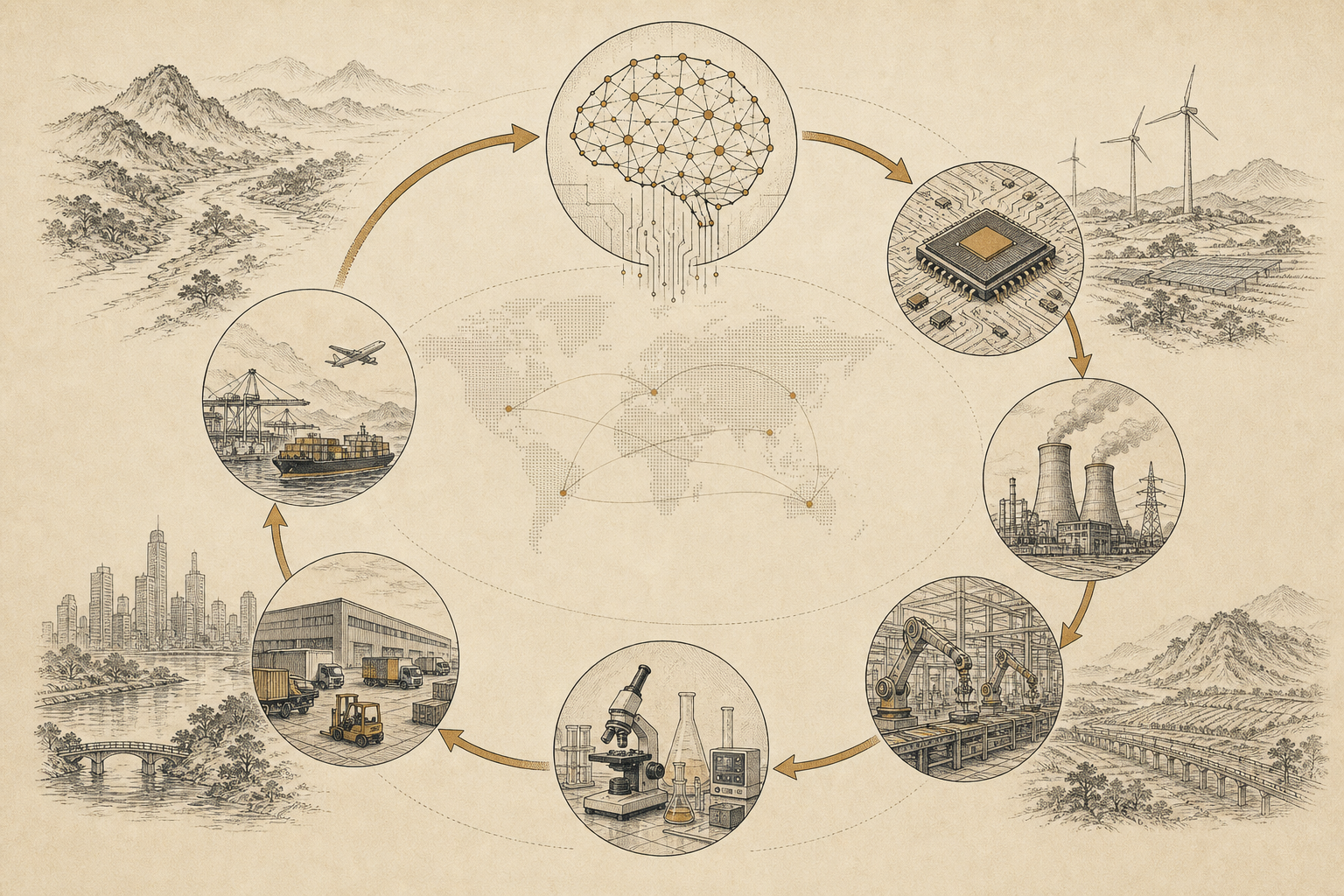
Finance and capital markets provide another amplifier. If capital believes intelligent capability will keep improving, and that larger clusters, better models, and stronger products will generate future returns, more funds will flow into compute, chips, energy, and model companies. Capital compounding and intelligent compounding become entangled: expected returns drive investment, investment expands compute, compute improves models, and model improvement strengthens the expectation of returns. This structure can create real growth, but also bubbles and concentration. Either way, capital markets become an accelerator inside the third curve, not a spectator outside it.
Organizational change should be placed inside this larger picture. Knowledge bases and employee AI accounts are only surface phenomena. The deeper issue is whether an organization can connect its production process to external intelligent infrastructure. Which tasks can models handle? Which feedback can return? Which data can be opened? Which permissions can be delegated? Which judgments must remain human? Which logs must be auditable? Which errors must be cleaned? Organizational capability will increasingly depend on managing intelligent loops, not only managing roles and processes. The boundary of the organization also changes: in addition to employment, department, and asset boundaries, there will be context boundaries, model boundaries, permission boundaries, log boundaries, and responsibility boundaries.
The individual also changes. A person entering production may carry models, knowledge bases, automation tools, long context, and platform permissions. Their capability comes from internal skill and from the intelligent infrastructure they can call. The boundary of personal capability becomes partly externalized. The basic action unit in society becomes a more complex composite node. A person's position on the third curve depends on whether they can access stronger intelligent infrastructure, maintain judgment boundaries, and make external systems part of long-term capacity.
The real social spillover is this: AI compounding is centered in models and R&D systems while also entering software, science, organizations, education, and industrial infrastructure. Social production is no longer only “humans using tools”; it also becomes “humans entrusting parts of production to intelligent systems that keep upgrading.” This entrusting will not happen evenly and will not come without cost. It creates new concentration, new dependency, new security problems, and new responsibility gaps. Whoever controls the strongest models, most compute, richest data, deepest workflows, and most important platform entrances may control a thicker social compounding account. The third curve is not naturally democratic.
As the third curve moves deeper into society, the issue stops looking like growth alone. Who owns the intelligent infrastructure? Who can use the strongest models? Who can mobilize the largest compute clusters? Who controls key data, interfaces, permissions, and logs? Who decides which tasks may be automated and which require human responsibility? When social production connects to the third curve, growth speed and institutional order are rewritten together. Growth itself creates new objects of governance: model weights, compute clusters, data assets, agent permissions, automation workflows, audit logs, and platform interfaces.
This is why the essay cannot stop at growth. If AI remains an occasional tool, institutional questions can stay around product liability and data governance. Once it becomes intelligent infrastructure for social production, and once it compounds through context, feedback, permissions, and action chains, the old assumption that tools are merely external extensions of people becomes insufficient. The curve inevitably touches authorization, revocation, audit, responsibility, and platform governance. It is no longer only a growth curve. It becomes part of the chain of social action.