Closing / 6 parts
After the Third Curve
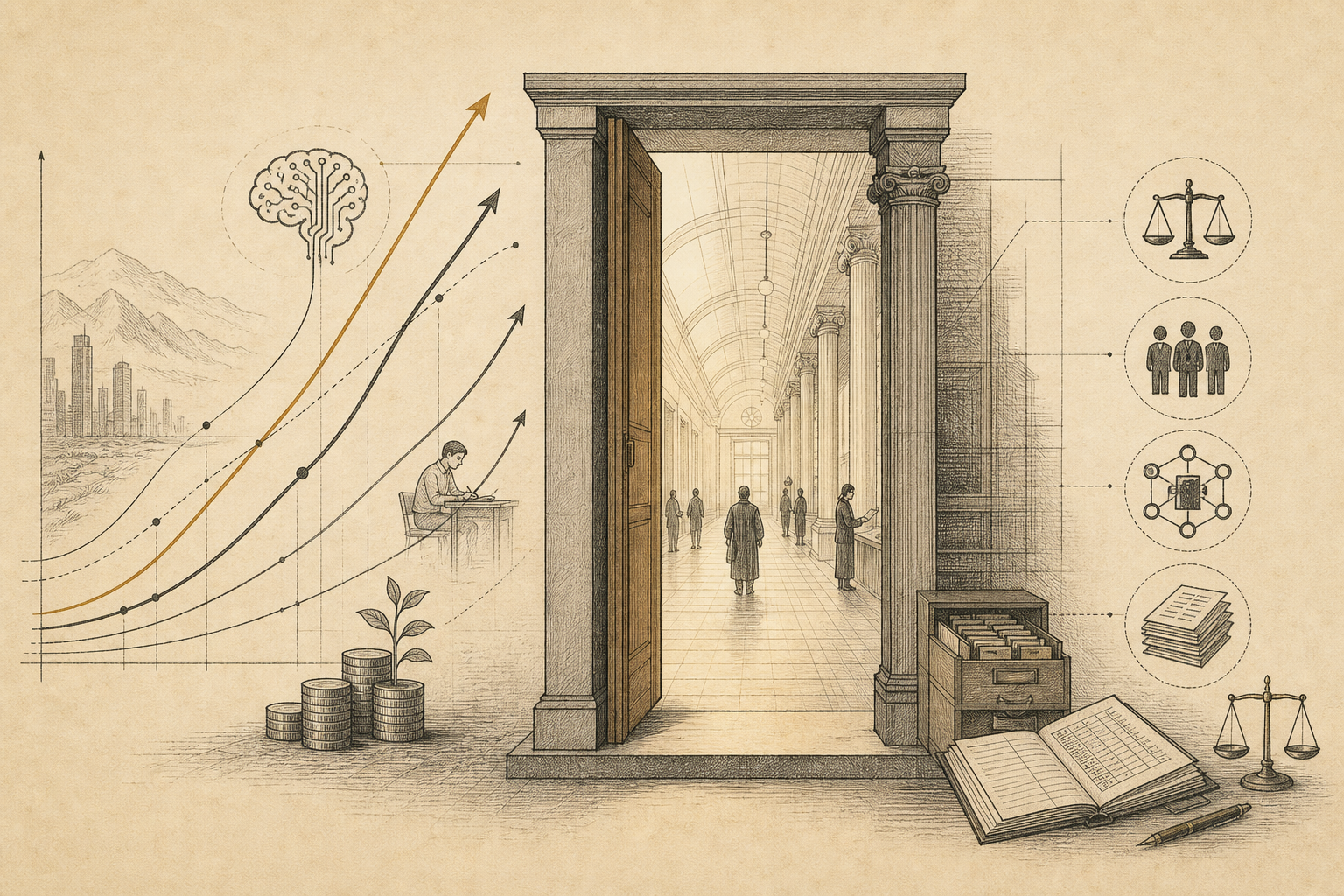
Capital, skill, and AI compounding form a new layered growth structure.
Closing
The Third Paradigm of Compound Growth: Closing
Return to the first question: why place AI inside the discussion of compounding? Not because AI is new, and not because it has already guaranteed long-term returns. More precisely, AI changes the relationship between intelligence and time. In the older growth imagination, capital compounding was visible and skill compounding was increasingly acknowledged; tools were usually understood as stepwise platform changes. After AI, tools may for the first time connect use, feedback, retention, and reuse into a loop, and may further let intelligence participate in producing the next round of intelligence. That moves the question of how intelligence is produced toward the center of the growth model.
Capital and skill do not leave the stage. Capital still determines the scale of mobilizable resources. Skill still determines judgment, direction, and quality. Without capital, many systems cannot be built. Without skill, tools amplify disorder rather than capability. What the third curve changes is that AI moves from external tool toward an intelligence system that can accumulate and feed back into its own production conditions. When intelligence begins to produce intelligence, capital, compute, algorithms, data, and automated R&D interlock into a stronger acceleration structure. Capital compounding fuels clusters and model companies. Skill compounding keeps shaping human direction. AI compounding places model iteration, search, feedback processing, and system improvement into more automated loops.
The curve should not be romanticized. AI is not a natural compounding machine. Temporary Q&A does not automatically retain experience. Generated content does not automatically become knowledge. Larger models do not automatically solve every bottleneck. Compounding requires conditions: context must be preserved, feedback must enter the system, experience must be retained, retained structure must be reused, and errors and noise must be cleaned. Intelligence-producing-intelligence also meets constraints in compute, data, evaluation, hardware manufacturing, real-world feedback, and governance. Compounding is not magic. It only says that this round of capability can enter the production of the next round.
This is why the essay has emphasized time. What matters is whether the system is better after ten, a hundred, or a thousand uses; whether one, two, or three model generations later, intelligent systems are modifying their own production conditions faster. A single impressive output only shows current capability. What changes the world is whether capability improvement enters the next round of capability improvement and alters the time scale of science, software, manufacturing, and organizations. AI's deepest effect may not lie in a single output, but in society adapting to a new tempo: more experiments, denser feedback, faster software, wider search, more concentrated capital, and more intense infrastructure buildout.
This essay asks how AI changes tools. The question is no longer only whether tools can raise efficiency, but whether tools are still merely external instruments. Once intelligent systems enter production and participate in producing the next round of intelligence, old production organization, personal capability boundaries, capital allocation, and growth narratives all have to be revalued. Excessive specialization becomes suspect because the radius of a single action unit expands. The third curve matters because that radius may not expand only once; it may thicken over time.
The forecast is not that AI will simply double everyone's productivity. A more precise forecast is that intelligent capability will increasingly behave like infrastructure embedded across social production; some production activity will enter feedback-rich, retainable, reusable, automatically iterable loops; intelligent systems will participate in modifying their own next-round production conditions; capital and state capacity will mobilize around compute, energy, chips, data, and security. This will not happen evenly and will not bring only efficiency gains. It will create new concentration, new fragility, new dependency, and new institutional pressure.
The conclusion should remain restrained. The third curve is not a guarantee of victory. It does not automatically reward every AI user or distribute itself evenly across organizations. It is more likely to reward systems that can combine compute, data, engineering, feedback, evaluation, and governance into stable loops. Whoever can make intelligent capability improve next-round capacity after completing this-round tasks is closest to the curve. A system that merely consumes model outputs without preserving context, cleaning errors, building evaluation, or retaining experience is still performing one-off efficiency on a higher platform. The third curve is not a public slope handed to everyone by model providers. It is a way of producing capability that has to be organized, operated, and governed.
Capital compounding brings returns back into principal. Skill compounding brings experience back into the person. AI compounding means model intelligence keeps rising and feeds back into the intelligence used to train models. The third paradigm of compound growth is this: AI begins not only to help us complete tasks, but also to change the starting point of next-round capability. Context, workflow, and memory inside tools are only the personal and organizational expression of that curve; deeper down, model capability keeps rising through frontier iteration, and AI begins to participate in data, training, evaluation, and next-generation model improvement. Model upgrades let everyone connected to the system stand on a higher intelligence platform, while AI-assisted R&D helps produce that platform faster. Once that curve enters social production, the question moves from growth to institutions: who owns the capability, who can call it, who may revoke authorization, who audits it, and who bears the consequences. In the past, tools changed human capability without independently entering the order of authorization, revocation, audit, and responsibility. When AI systems preserve context, accept goals, and modify next-round action conditions, they move from external extensions of people into quasi-nodes in chains of social action.
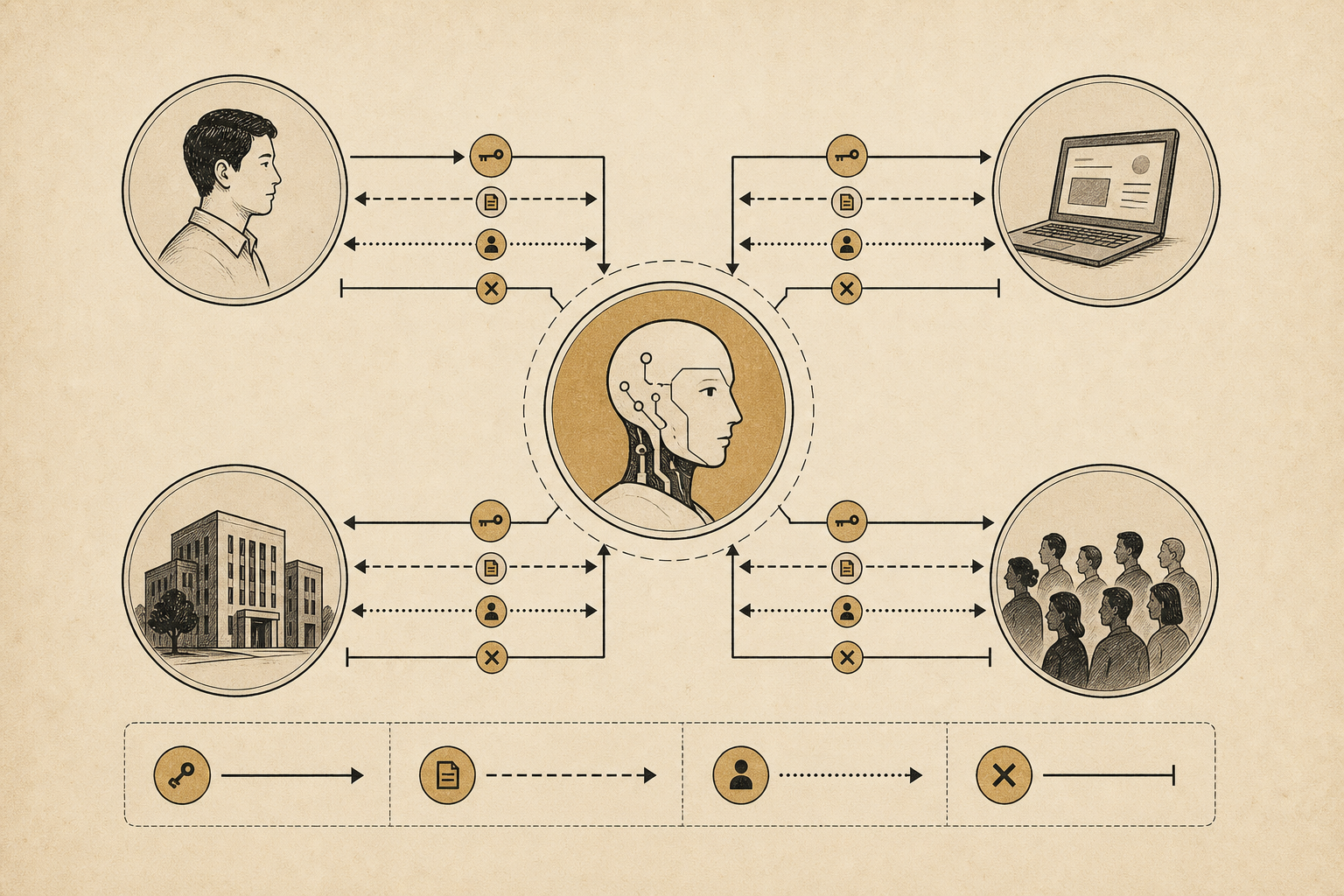
The third curve therefore unsettles more than the productivity model. It also unsettles the old social assumption about the place of tools. The older contract assumed natural persons were the stable nodes of society and tools were external extensions. Once tools have memory, context, permissions, feedback, and action capability, they affect third-party interests, organizational boundaries, and responsibility allocation. The question shifts from whether AI improves efficiency to who can delegate which capability to an agent, to what degree, how that delegation can be withdrawn, how it is audited, and who is responsible when something goes wrong. After the third curve, growth naturally pushes into institutional order. This is not a teaser for another essay. It is the endpoint of the curve itself: when tools participate in producing next-round capacity, they enter the core of how humans arrange power, responsibility, and trust.