Chapter 3 / 6 parts
Intelligence Begins to Produce Intelligence
The steepest form of the third curve appears when stronger AI helps make the next generation of stronger AI.
Chapter 3
The Third Paradigm of Compound Growth: Chapter 3
At this point, the third compounding curve is still a tool-layer thesis: AI systems can preserve context, receive feedback, retain experience, and turn this task into a condition for the next. That is already important, but it is not the strongest part. What separates AI compounding from ordinary tool reuse is that it may enter a deeper loop: intelligence begins to participate in producing the next round of intelligence. Traditional tools rarely did this. A machine tool can make parts, but it does not usually redesign the next generation of machine tools. Software can improve engineering productivity, but the software itself does not automatically conduct the next generation of software research. Tools amplified researchers; they did not become part of the research population.
AI breaks at this point. A sufficiently capable model can read papers, write code, generate experiment plans, analyze training logs, find bugs, compare architectures, create synthetic data, run evaluations, and propose optimizations. Once it enters the AI R&D process, progress no longer comes only from the slow accumulation of external human researchers. It begins to come partly from intelligent systems modifying their own production conditions. Better models make AI R&D faster; faster AI R&D makes better models more likely. Chapter two asks whether task experience can return to the tool system; this chapter asks whether intelligent capability can return to the system that produces intelligence. One changes workflows; the other changes capability growth itself.
This is where scaling laws and compounding can be bridged. Scaling law is not financial compounding. It describes a relatively predictable relation between effective scale and model capability. Compute, data, parameters, training methods, inference-time computation, and post-training techniques all move the capability curve. As long as that relation does not fully break, capability advances with effective scale. The sharper question is what happens when models themselves help increase effective scale: the curve is no longer only “humans invest more resources and models become stronger,” but “stronger models help humans make stronger models faster.” Scaling law supplies the underlying slope; AI-assisted R&D supplies a mechanism that can make the slope steeper.
A more cautious framing is that AI compounding has two layers. The first is model-level scale compounding, driven by compute, data, and algorithmic efficiency. The second is R&D-level recursive compounding, driven by AI entering the research workflow and modifying algorithms, data, evaluation, engineering, and tooling. The first layer makes models stronger; the second makes the process of becoming stronger faster. Together they form the structure that matters when people imagine a path from AGI to much stronger systems. It does not require miracles at every step. It requires many links to be compressed: faster experiments, faster code, faster evaluation, faster data generation, faster architecture search, faster debugging.
The AGI-to-ASI imagination should not be reduced to one model crossing a mystical threshold. The more important change is that strong AI becomes large-scale research labor. It can run many copies, test many directions, work continuously on code and experiments, and compress a search space that previously required years of human attention. Even if each AI researcher is not a genius, enough quantity, speed, and feedback density can change the system-level research capacity. In the past, a lab's progress depended on limited human attention. In the future, human judgment may remain crucial, but a large portion of intermediate work can be absorbed by external intelligent systems.
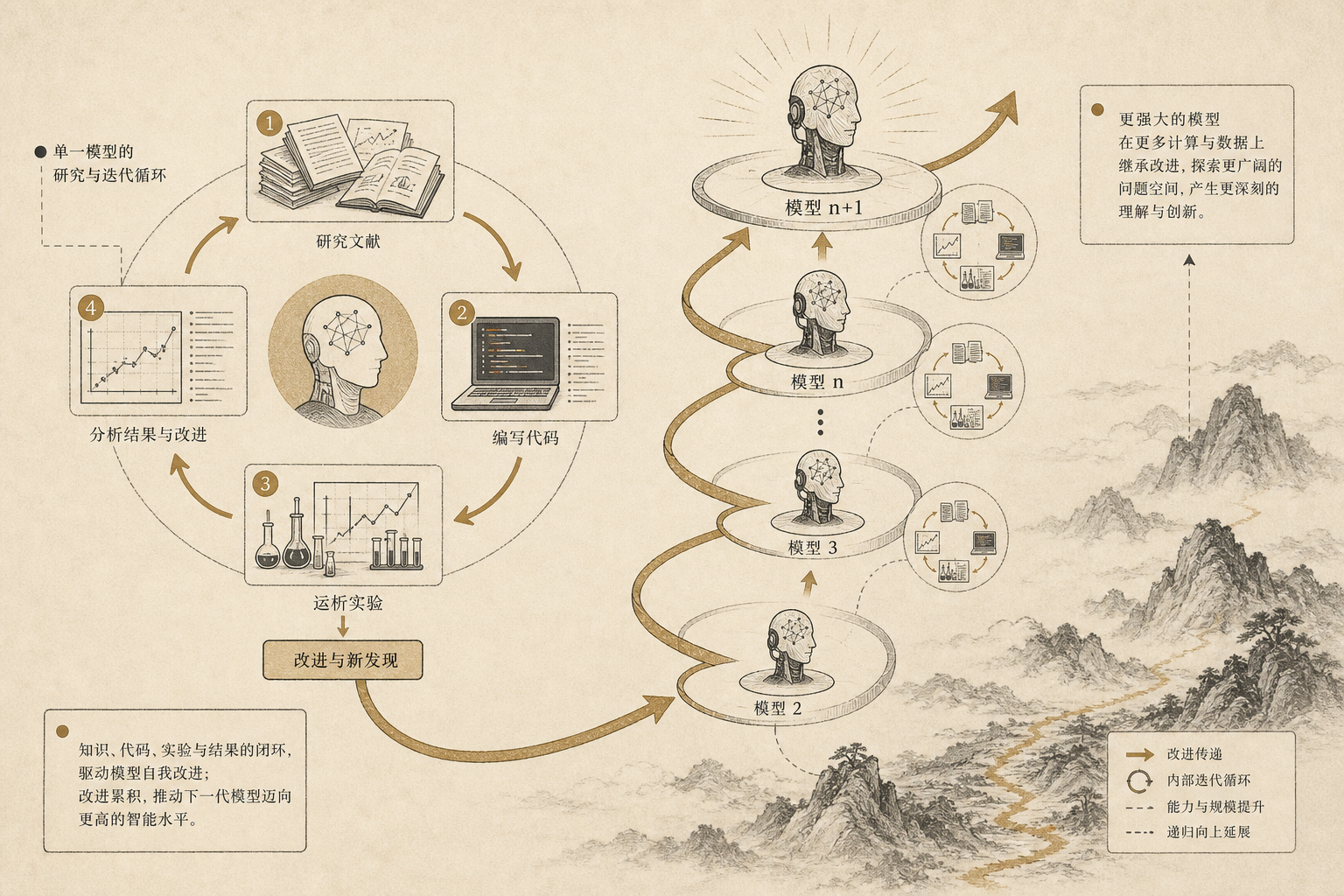
This will likely happen first inside AI R&D itself, because AI labs understand which parts of their own work can be decomposed, evaluated, and automated. Training scripts, model evaluations, data cleaning, inference optimization, benchmark design, failure-log analysis, code refactoring, and parallel experiment scheduling all live in highly digital environments. An agent does not need complete scientific intuition to create real acceleration in these links. More importantly, the gains from these links return to the model-production process. Better evaluation screens out wrong directions; better training infrastructure releases more experimental budget; cheaper inference lets more automated research copies run.
There is also an “unhobbling” layer. A model that moves from a chat box into an agent that can use tools, call code, plan over long horizons, read files, maintain memory, and execute tasks is not merely the same model with a new interface. Many capabilities that existed in representation were constrained by short conversations and single outputs. Longer context, reliable tool use, stronger reasoning loops, and stable execution environments can release more real capacity than static benchmarks suggest. The third curve therefore comes not only from larger parameters, but from putting models into longer action loops.
This recursion does not guarantee infinite acceleration. There are bottlenecks: experiments need compute, data needs quality, evaluations can be distorted, real-world feedback has delays, hardware cannot be replicated like software, and organizational decisions can slow things down. Stronger models do not automatically know the correct research direction, and automated experiments can generate noise. Compounding is not magic. It only means that this round of capability can enter the production of the next round. How far the curve rises depends on where the hard bottlenecks are.
Even with those bottlenecks, the structural change is large. AI progress used to be limited by scarce researchers, engineering teams, compute budgets, and experiment cycles. Now intelligent systems begin to perform part of the research labor themselves. They do not need to replace scientists completely. If they continuously improve parts of the research pipeline, effective R&D speed changes. Code is faster, experiments multiply, evaluation becomes denser, tooling becomes more automatic, and the tempo of model iteration may reset. Human researchers still provide direction, judgment, and boundaries, but the production system is no longer purely human.
Trillion-dollar clusters belong in this story. They convert enormous hardware investment into the industrialization of intelligence-producing-intelligence. Giant data centers provide training and inference compute. Capital funds the next model. Energy and chips become strategic infrastructure. Research workflows are surrounded by automated systems. Capital compounding, compute expansion, algorithmic efficiency, and AI-assisted R&D begin to interlock. The third curve leaves the workflow of an individual and enters the continuous production system of the AI industry.
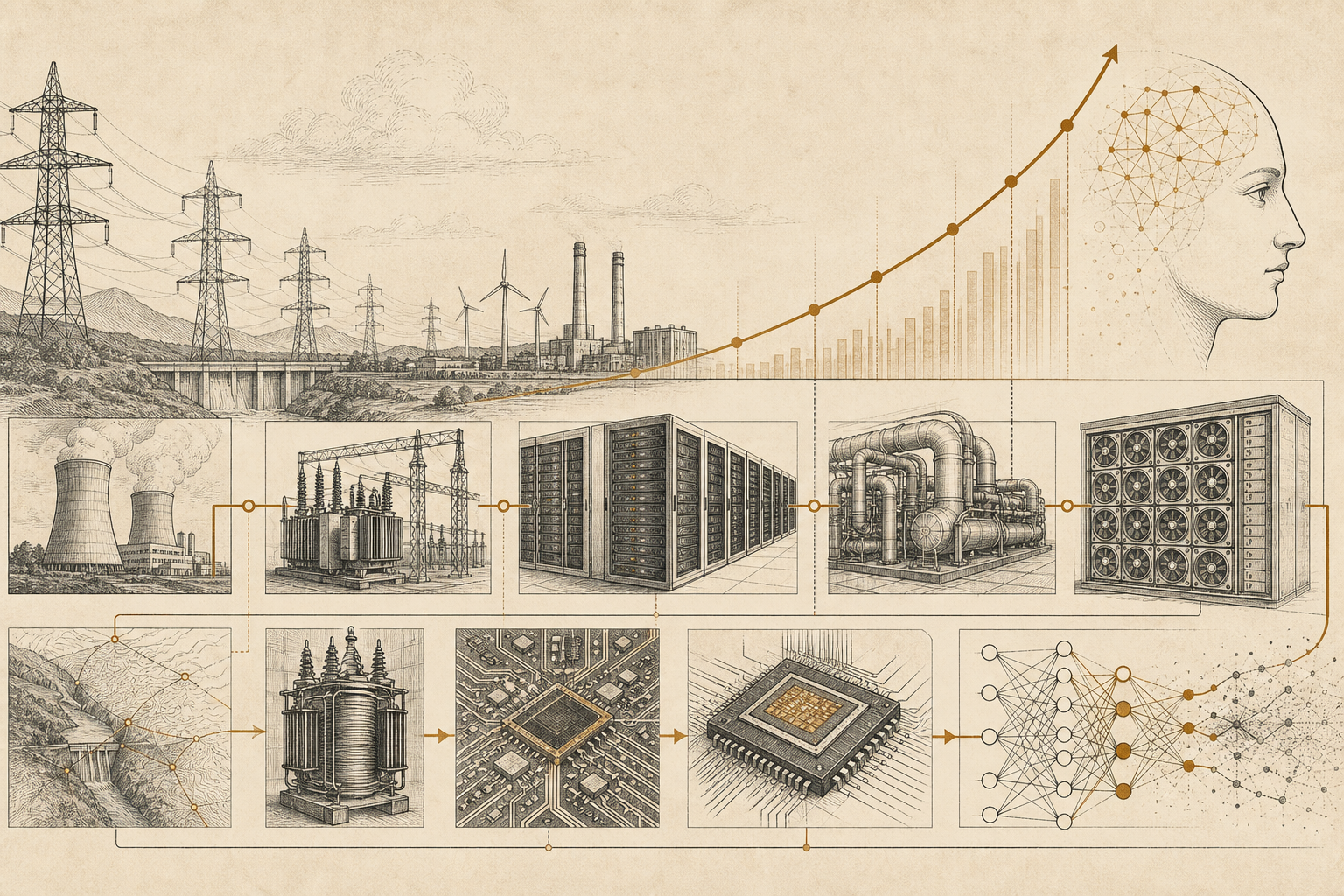
This is why the phrase “super-compounding” sounds exaggerated but points to a real object. Ordinary compounding returns gains to principal. AI recursive compounding returns intelligent capability to the system that produces intelligence. Ordinary technological progress depends on humans applying new tools to the next round of R&D. After AI, tools themselves may perform a growing share of the next round of R&D labor. The qualitative shift is not whether a model already has every human ability. It is whether intelligent labor becomes copyable, parallelizable, schedulable, evaluable, and deployable into its own improvement.
The key judgment of this chapter is that the strongest form of AI compounding appears after intelligence enters the production process of intelligence. Traditional tools raise human capacity. AI may raise the capacity to raise capacity. Once that becomes true, the third curve is no longer only about workflow efficiency. It becomes a forecast about the future speed of intelligence growth.