The Third Paradigm of Compound Growth
From capital compounding and skill compounding to AI compounding
This essay asks how AI changes the time structure of intelligence itself: from external tools to systems that can help produce the next round of intelligence.
Contents
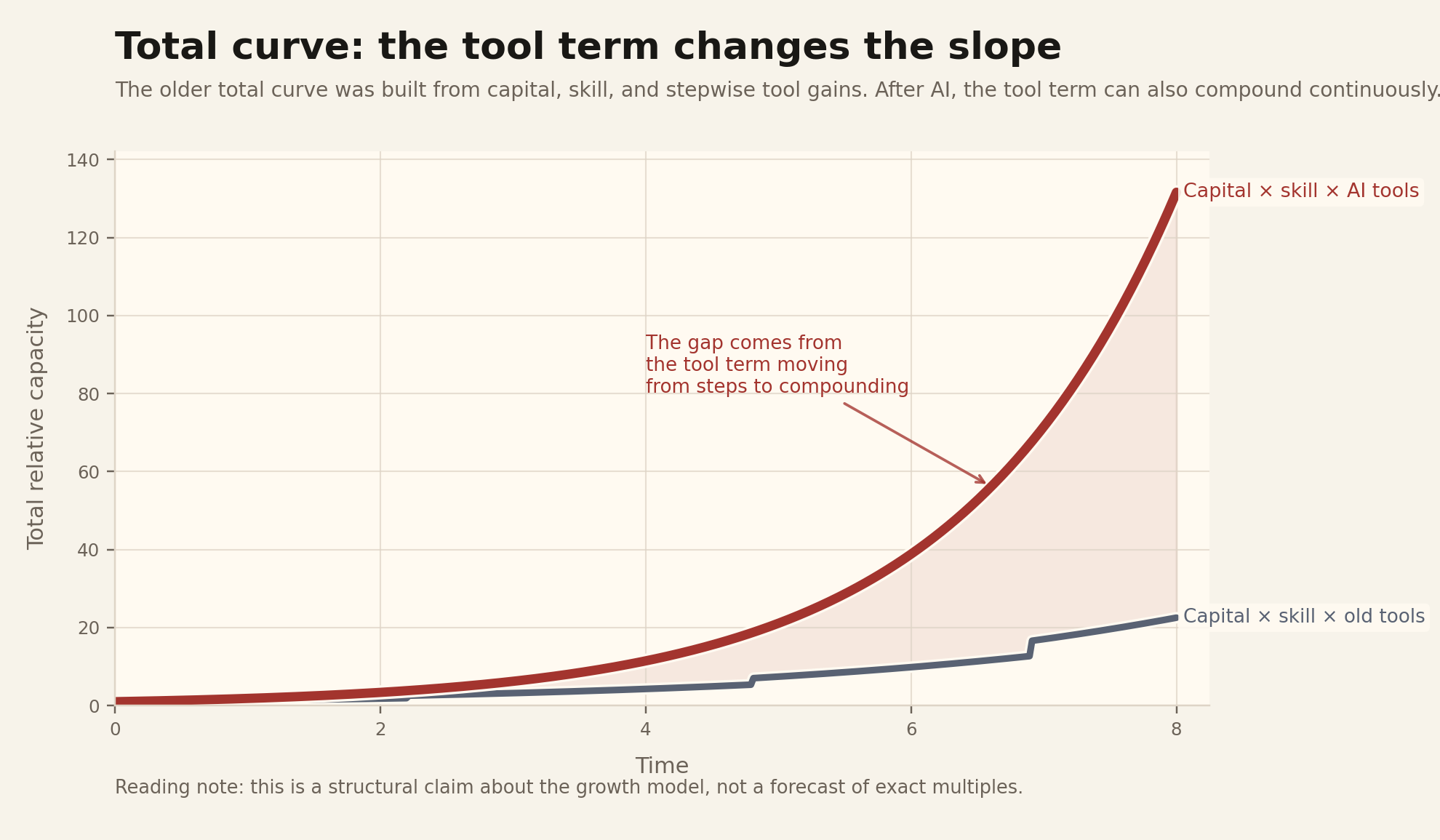
The old growth coordinates: capital compounding + skill compounding.
Traditional tools: more often raised the platform by one step.
AI compounding: intelligence begins to participate in producing the next round of intelligence.
The Third Paradigm of Compound Growth: Introduction
Capital compounding brings returns back into principal. Skill compounding brings experience back into the person. AI compounding means model intelligence keeps rising and feeds back into the intelligence used to train models.
Introduction: Compounding Is Humanity's Tenth Wonder
To understand modern growth, we have to ask why division of labor once produced so much efficiency. On the surface, division of labor splits complex work into smaller parts. One layer deeper, it also lets skill accumulate, thicken, and return to production over time. In the pin factory story from The Wealth of Nations, specialization is also a story about repeated action, thickened judgment, fewer errors, and tools redesigned around a stable task. Division of labor looks like a spatial division of work, but underneath it there is a temporal line of accumulation: repeated skill turns the residue of one task into the starting point of the next. That is the time compounding of skill.
Capital compounding is the more visible curve. When people talk about compounding, they often think of Warren Buffett, not because every single year was spectacular, but because returns could be preserved, owned, reinvested, and rolled forward over a long enough period. The power of capital compounding comes from turning time into part of the structure: one round of return re-enters the next round of principal. In the old growth imagination, two stable curves were therefore clear: capital compounds through assets and cash flows; skill compounds through experience, fluency, and judgment. Much of what modern society calls long-termism rests on those two intuitions.
But tools always occupied an awkward position. Tools are obviously central to modern productivity. Without steam engines, electricity, computers, and the internet, neither capital nor skill could have been released at today's scale. The point is not that traditional tools were unimportant. The point is that their growth pattern was different. Many tools raise the platform once they are invented, adopted, or upgraded, but after that they do not necessarily absorb experience from each use. A hammer does not inherit the hand-feel of a master after being used ten thousand times. Ordinary software does not automatically understand an organization's judgment after processing a hundred projects. Traditional tools were closer to step changes than to continuous compounding. They could transform industries, but their improvement usually came from the next invention, device replacement, version release, or infrastructure upgrade.
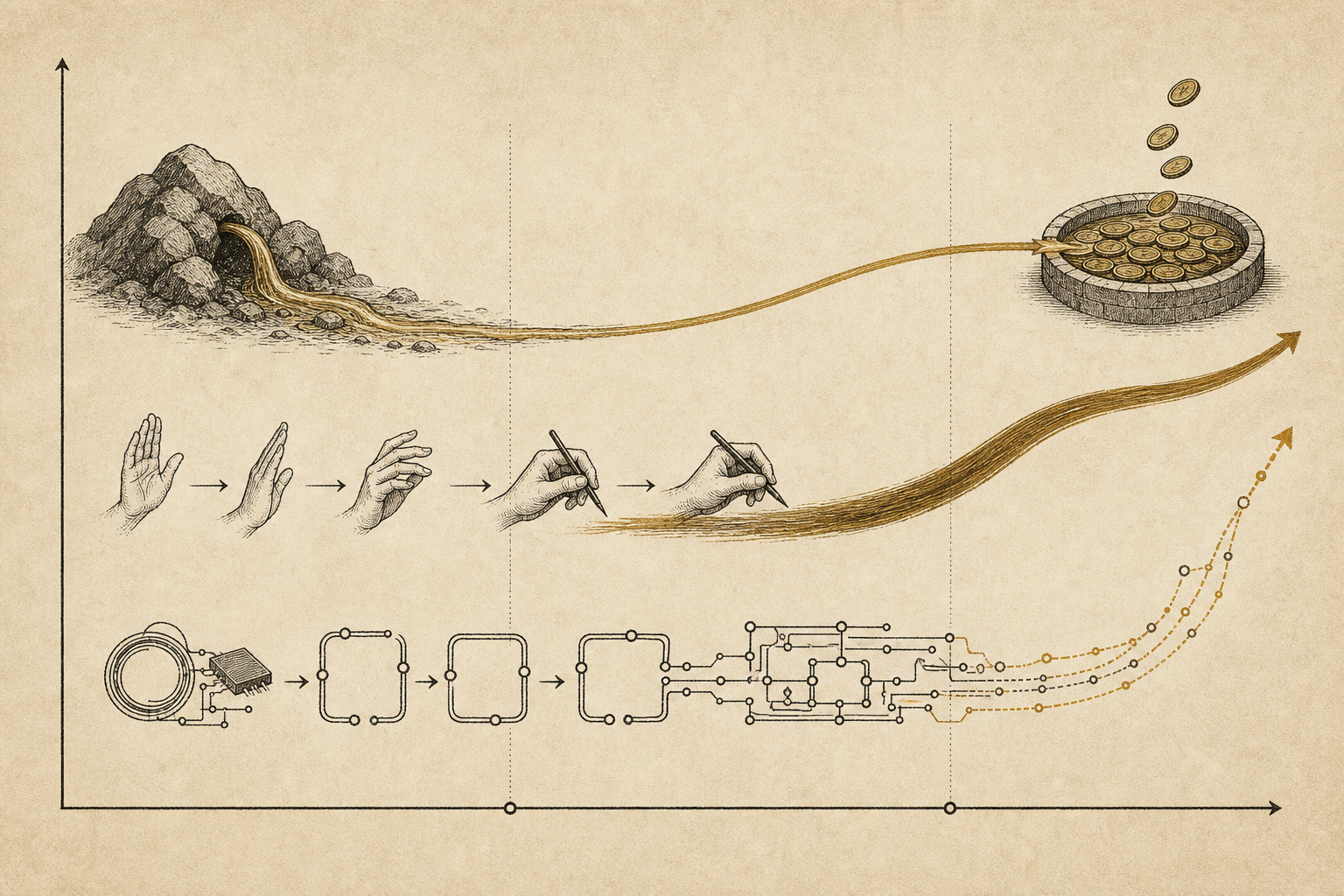
AI becomes special at exactly this point. It can still be used as a tool, but if AI compounding is reduced to prompt history, context, workflow, memory, or agent rules, the argument becomes too shallow. User-side tool compounding is only the first layer: a prompt, an edit, a failed example, a review standard, a knowledge-base entry, or a workflow template can move from the trace of one use into the condition of the next use. Individuals and organizations can preserve feedback, templates, checklists, and agent behavior constraints, so the next task no longer starts from zero. That is real compounding, but it is the downstream workflow expression of AI compounding.
The deeper form of AI compounding is that model intelligence keeps rising and feeds back into the intelligence used to train models. It has at least two simultaneous sides. One is platform-level model-capability compounding: pretraining is not over; post-training, scaling, data, synthetic data, RL, tool use, and reasoning are still raising the ceiling. The other is intelligent self-improvement: once AI starts to participate in data generation, training, evaluation, algorithmic research, and next-generation model construction, intelligence itself helps make stronger intelligence. Every few weeks or months, frontier labs ship stronger models; a user can open the same tool and get more capability even without accumulating much context, simply because the underlying model has improved. AI-assisted R&D then feeds back into that same model-upgrade process.
This is the key step in the AGI-to-ASI discussion. AI does not need to automate all real-world work first. If it first automates AI research, it may compress years or even a decade of algorithmic progress into a much shorter cycle. Many AI researcher agents can run experiments, modify training recipes, generate data, write evaluations, and search for algorithmic improvements. The ceiling of intelligence then keeps moving upward. The third curve is no longer merely about tools becoming smoother to use. It is about intelligence producing stronger intelligence.
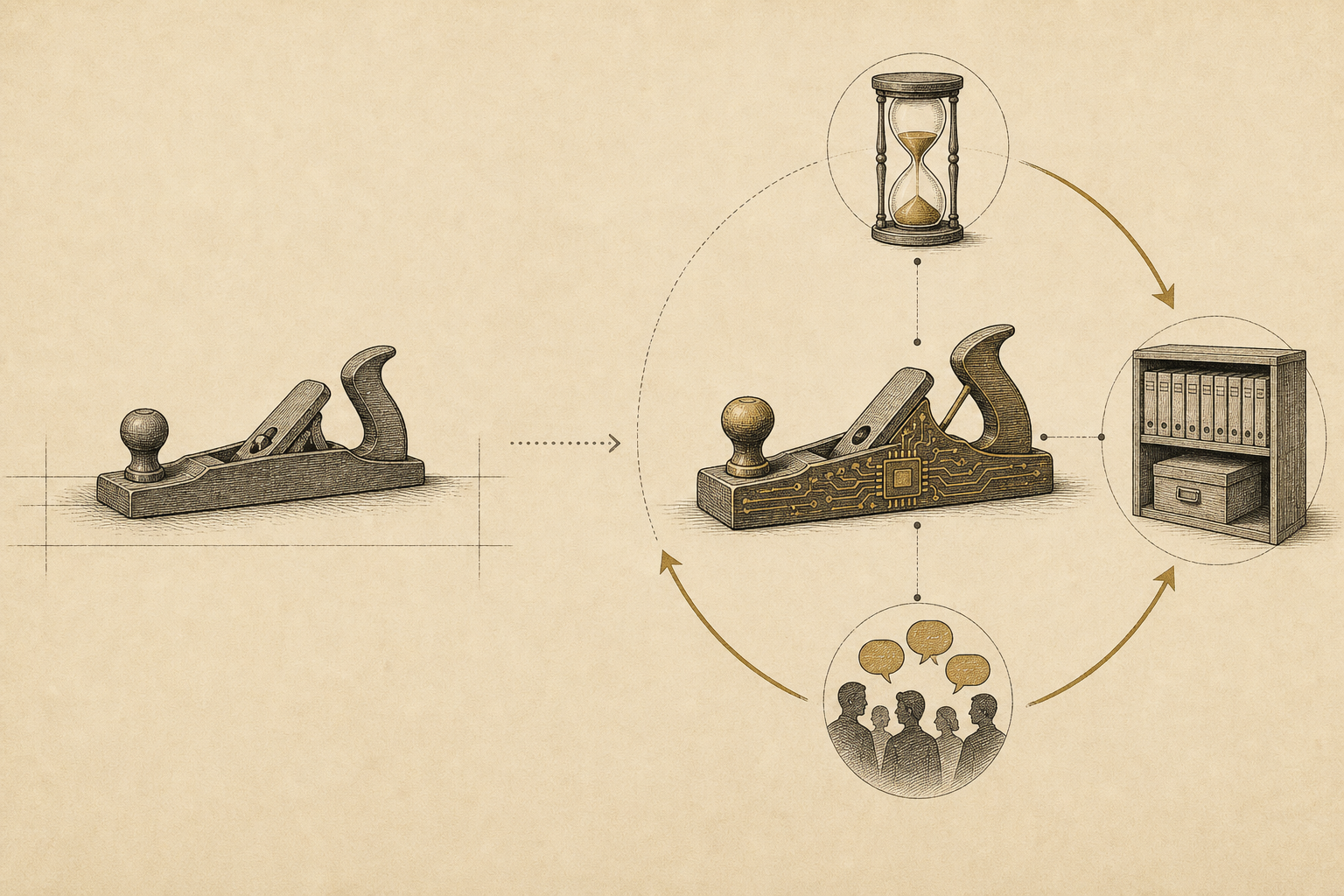
By the third paradigm of compound growth, this essay does not put AI against capital and skill. Capital decides how many resources can be mobilized. Skill decides what can be judged and directed. AI compounding decides whether the intelligence base and externalized capacity can thicken over time. The three are layered, not mutually exclusive. The question is no longer just whether AI will replace someone. The deeper question is how growth changes when models keep improving, tool systems store feedback and reuse context, and AI begins to participate in training, evaluation, data generation, and algorithmic research. The rest of the essay asks why this was harder to see with traditional tools, why AI makes the judgment loosen, why the curve becomes much steeper when intelligence begins to produce intelligence, and how that curve may enter the larger system of social production.