Chapter 2 / 6 parts
The Tool Layer of AI Compounding
Context, feedback, retention, and reuse are the first layer of AI compounding in personal and organizational workflows.
Chapter 2
The Third Paradigm of Compound Growth: Chapter 2
AI is still a tool. This judgment has to come first, because once AI is described as a force outside the category of tools, the discussion easily becomes mythology. AI does not automatically make a person intelligent or a company advantaged. It can generate, summarize, reason, code, retrieve, plan, and call systems, but those abilities still have to enter specific tasks, serve specific goals, and accept specific evaluation. At the tool layer, the important question is that AI gives tools, for the first time, a plausible path into a compounding state. Traditional tools mostly look like steps. AI differs because it can enter the semantic layer of work: it can read context, understand goals, reference examples, reuse prior outputs, and revise the next action according to feedback.
This changes the relationship between tools and time. In the past, the longer you used a tool, the more fluent you became. Now, the longer you use an AI work system, your fluency may improve and the system itself may also accumulate callable structures. Prompts improve, templates settle, knowledge bases thicken, cases accumulate, evaluation standards become clearer, and workflows become more stable. When the next task begins, you no longer face a blank sheet; you face a piece of externalized capacity reshaped by previous work. This is the tool layer of AI compounding in personal and organizational work. But it does not happen automatically. A temporary answer, a copied draft, or a summary that never enters a knowledge base is still one-off efficiency.
Compounding begins when the output of this round improves the capacity of the next round. For AI, that usually requires four conditions: context, feedback, retention, and reuse. Without context, AI can only give generic answers. It may be fast, but it has to guess your goal, constraints, style, history, and stage. Context turns a general tool into a tool inside the current task. It knows what essay you are writing, which claims have already been formed, which tone must be avoided, which sources can be cited, who the reader is, and whether the current goal is to expand a chapter or write a short title.
Feedback tells the tool what a good result means. Without feedback, AI is merely producing. With feedback, it can begin to iterate. Feedback may come from human revision, tests, reviews, user behavior, business metrics, compilation errors, fact checks, or quality scores. In writing, feedback may be “this sounds like a slogan,” “the concept drifted,” or “keep the judgment but remove the viral tone.” In code, it may be failed tests, type errors, performance regressions, or logs. Feedback compresses an abstract goal into a direction that can be corrected.
Retention is the key to compounding. A good answer disappears if it is merely read. A useful judgment is hard to reuse if it only remains in one person's head. A failure repeats if it is never recorded. The tool layer of AI compounding requires experience to become a callable structure: prompts, templates, workflows, knowledge-base entries, case libraries, evaluation rules, scripts, or agent instructions. The form matters less than whether it can enter the next action. Archiving is not retention. A document that cannot be retrieved, updated, or used in decision-making is inventory. A knowledge base that can be retrieved, cited, compared, challenged, and used by AI in the next round becomes compounding material.
Reuse decides whether retained experience returns to production. Many teams do not lack documents; they lack a path for documents to re-enter action. Many individuals do not lack notes; they lack a way for notes to be called when the next task begins. AI matters here because it lowers the cost of reuse. It can pull relevant experience back into the task as suggestions, constraints, drafts, checklists, or automated steps. When context, feedback, retention, and reuse connect, the tool enters a compounding loop: use AI for a task, receive results and feedback, turn valid experience into callable structure, call that structure next time, improve output speed or quality, and generate new feedback.

This also explains why “using AI” and “operating an AI workflow” are different. A person who uses AI may know prompt tricks and generate faster. A person who operates an AI workflow asks which tasks deserve retention, which context should persist, which standards must be explicit, which outputs become cases, which errors become checks, and which processes can become semi-automatic. The first uses a tool. The second makes the tool enter compounding. A writer who only asks AI to draft an article gets a time saving. A writer who gradually externalizes topic judgment, title preferences, rhythm, reader profile, counterexamples, sources, and editing rules begins to build a writing system. A programmer who only asks for a snippet gets local acceleration. A programmer who connects project conventions, architecture boundaries, tests, common mistakes, debugging paths, and review standards to the toolchain begins to reduce repeated error.
There is an important boundary: the tool layer is not the whole of AI compounding. Frontier labs shipping stronger models raises the intelligence base for everyone; AI entering training, evaluation, data generation, and algorithmic research also reshapes the production process behind that intelligence base. This chapter focuses on the tool layer: can individuals and organizations embed AI in their own feedback loops so that each round of work improves the next? If everyone uses the same stronger model, the public benefit of model improvement is quickly shared. The differentiator still moves to the structures around the model: better context, higher-quality data, clearer evaluation, more stable workflows, and faster feedback.
AI compounding is therefore technical, organizational, and cognitive at once. Technology determines whether tools can access context, call systems, retrieve knowledge, and execute tasks. Organization determines whether experience can be shared, permission managed, quality evaluated, and workflows redesigned. Cognition determines whether people understand what should be retained, what is noise, what should be automated, and what must remain human judgment. If you only see technology, you will think connecting a model is transformation. If you only see efficiency, you will call every AI use compounding. If you only see automation, you will miss judgment, responsibility, and feedback.
Bad experience can compound too. Bad templates can be reused, low-quality content can become future examples, vague standards can make future outputs more vague, and unchecked material can spread through the system. AI amplifies capability, but it can also amplify disorder. Compounding is not morally positive by default; it only says that this round affects the next. Effective AI compounding therefore has to be tied to evaluation. Without evaluation, more retention may create more noise. Knowledge bases thicken, template selection becomes harder, agents multiply, and responsibility boundaries blur. A real compounding system must continuously decide what deserves to enter the next round.
Humans remain important for exactly this reason. Their role changes rather than disappears. In older workflows, people directly executed: writing, calculating, searching, arranging, communicating, correcting. With AI, people still execute some work, but the more important role becomes defining goals, decomposing tasks, judging quality, designing feedback, deciding what to retain, cleaning noise, and maintaining boundaries. A person moves from being a single point of capacity to being the designer and operator of externalized capacity. This is harder than casual AI use. It requires making tacit experience explicit, turning vague preferences into standards, abstracting repeated processes, recording failure causes, and checking output quality.
Once the loop exists, time begins to work. In the first round, AI may simply help finish a task. In the second round, templates and feedback from the first round remove some friction. In the third, errors become checks and good outputs become examples. By the tenth round, the system is no longer a generic model. By the hundredth, the difference may have moved away from any single prompt and into the thickness of the entire workflow. That is the curve-feel of tool compounding. It rarely produces a huge leap in one use, but it makes the next use less like starting from zero.
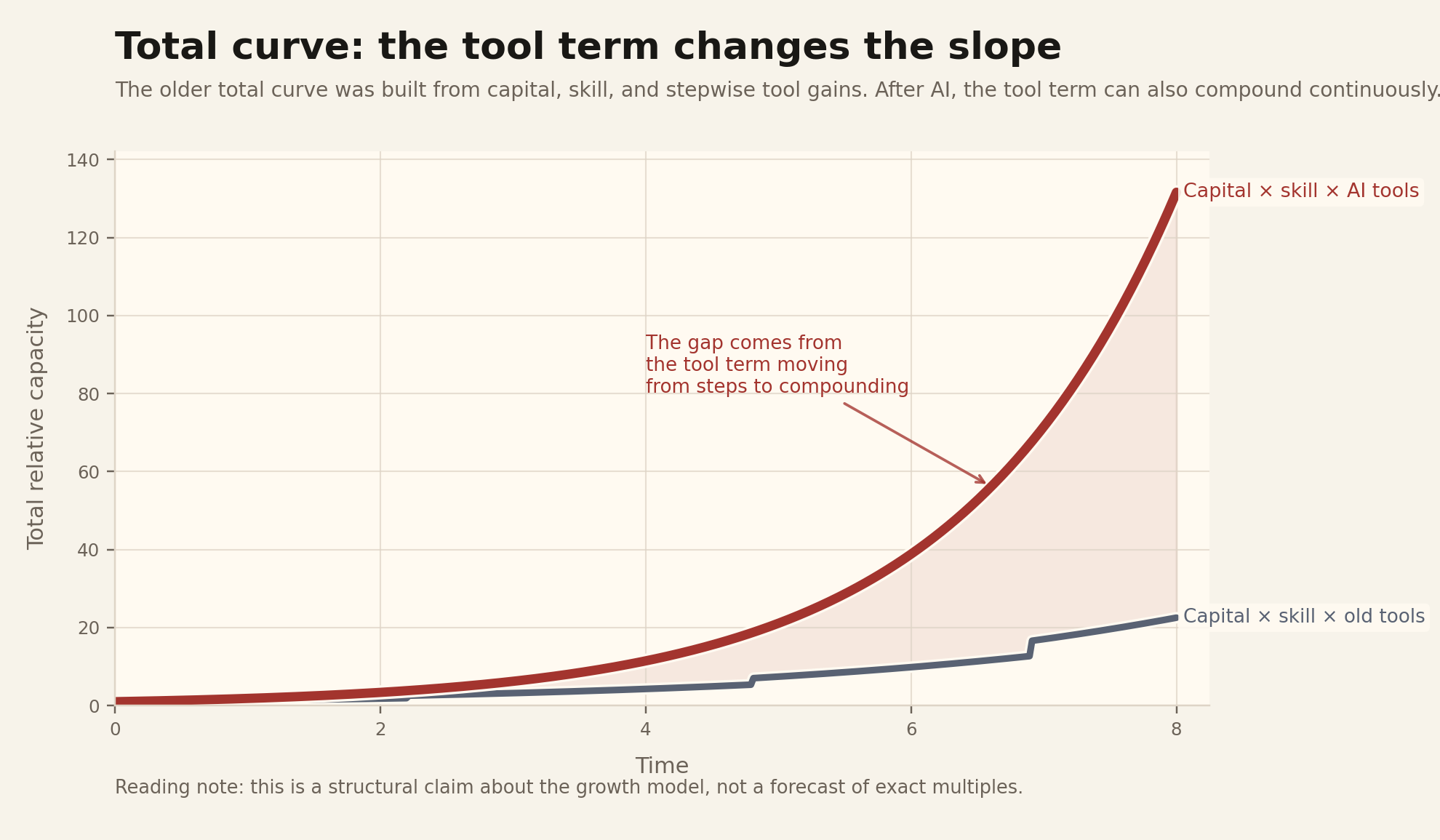
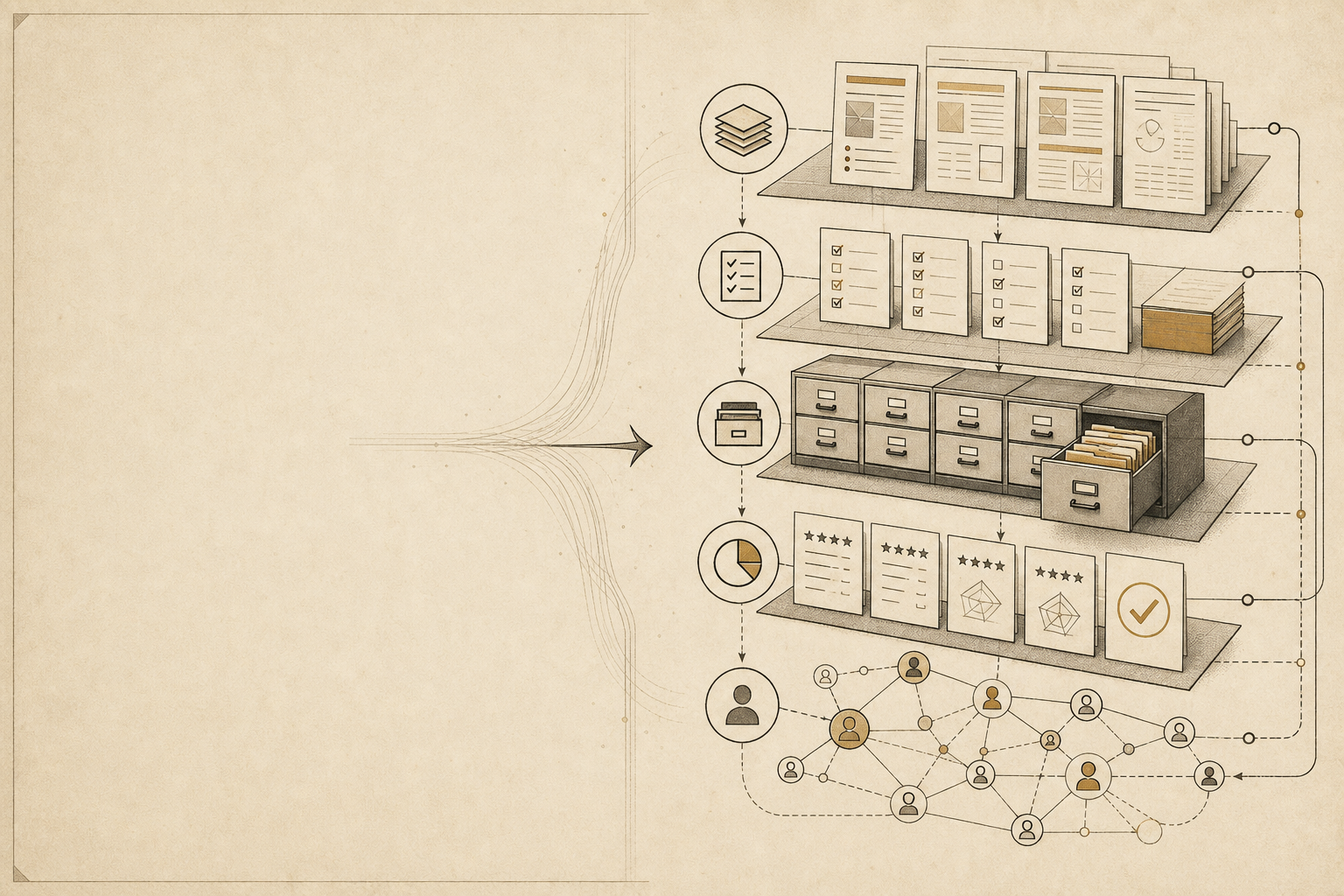
The reverse is also true. If every AI use is isolated, all context is lost, all feedback is unrecorded, and all outputs fail to enter the next round, then even a powerful AI remains a one-off tool. It may make a person faster, but it will not make the system better over time. To judge whether AI has entered a compounding state, ask five questions: can this round's context be called next time? Is there explicit feedback on output quality? Is valuable experience retained as reusable structure? Will the next task automatically or semi-automatically call that structure? Is there a mechanism to remove errors, noise, and stale experience? If the answers are mostly no, AI is still an efficiency tool. If they become yes, the tool approaches a compounding system.
This is the core of the tool layer of AI compounding: tools no longer only amplify the current action; they can participate in preserving and reinvesting experience. Capital compounding brings returns back into principal. Skill compounding brings experience back into the person. AI compounding appears here as task experience returning to the tool system so that the next action does not begin from zero. But this is the personal and organizational expression of the curve. The larger question is what happens when model capability keeps rising and this capacity system participates in producing the next generation of intelligence.