Chapter 1 / 6 parts
Why Traditional Tools Were More Like Step Changes
Traditional tools were enormously important, but most of them raised the platform rather than compounding through use.
Chapter 1
The Third Paradigm of Compound Growth: Chapter 1
Tools were never secondary in the history of human growth. Without tools, neither capital compounding nor skill compounding could really unfold. Capital enters production through tools; skill becomes action through tools. A farmer's experience is released through implements, a worker's fluency through machines, and a programmer's judgment through editors, compilers, networks, and computers. Tools have always sat inside the growth structure. Saying that traditional tools usually did not form a third compounding paradigm does not make them less important. They were too important to ignore. The question is that their importance was usually expressed as a series of step changes, not as a curve that kept bending upward through use.
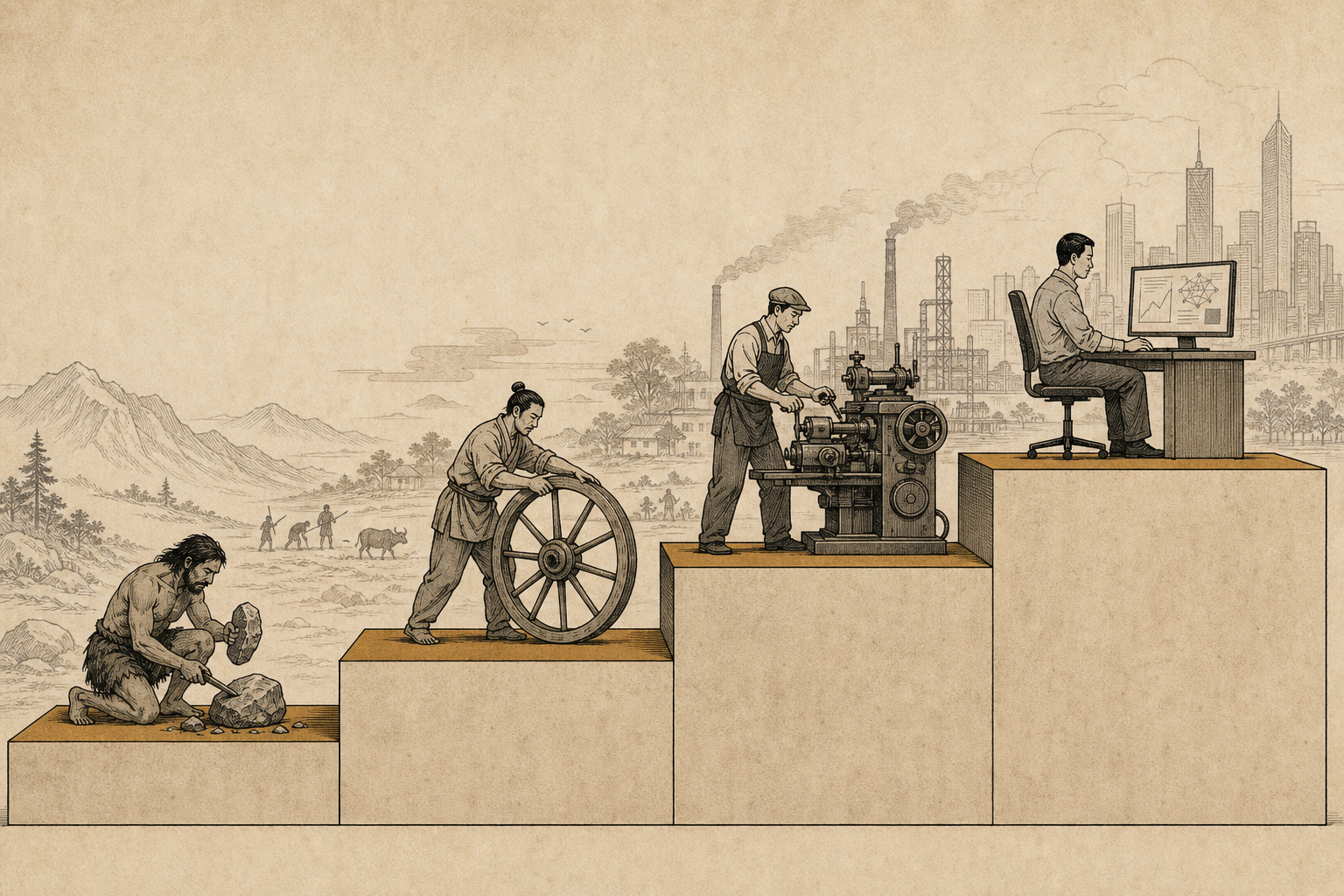
A step change means that a new tool appears, or an old tool is upgraded, and the efficiency platform rises. Humanity stands on the new platform and continues working there until another invention, equipment replacement, or infrastructure rollout raises the platform again. This kind of growth can be enormous. Stone tools improved cutting and hunting; farm tools improved land use; steam engines changed energy and transportation; electricity changed factories and cities; computers changed information processing; the internet changed connection and distribution. Every tool revolution moved human beings from one platform to another. But a raised platform is not the same as a tool compounding through your continued use of it.
A hammer does not understand your force, angle, and habit because you have used it a hundred times. What improves is your hand-feel and your judgment about materials and situations. A machine may raise output per hour, but it usually operates according to a fixed structure. People can become more fluent, managers can optimize processes, and machines can be maintained, but the machine itself usually does not absorb organizational experience from every production run. Ordinary software is closer to our current work environment. Document tools, spreadsheets, design tools, and project-management systems all improve human efficiency. They package operations into interfaces and turn repeated actions into buttons. But most traditional software still executes explicit instructions. It can store files without understanding the judgment behind them. It can record workflows without turning them into better action proposals next time.
The growth of traditional tools therefore usually happens outside the user's concrete use. A better hammer comes from materials and manufacturing. A better machine comes from engineering redesign. Better software comes from a development team shipping a new version. Users may provide feedback and markets may signal demand, but the tool's capability does not mainly improve through each specific act of use. This is the first distance between traditional tools and compounding: use makes the human stronger, but it does not necessarily make the tool stronger. Capital compounding works because returns can go back into principal. Skill compounding works because experience can go back into the person's next action. Traditional tools create gains, but those gains often do not return to the tool itself.
A simple example makes the point. Suppose someone uses a spreadsheet to make ten budgets. After ten rounds, that person may better understand the budget structure, the assumptions that fail, and the categories that require detail. But the spreadsheet itself does not acquire that judgment. The next blank sheet is still blank. The experience has accumulated in the person, not in the tool. Templates, macros, scripts, and automation can move part of that experience into the tool, and those are important predecessors of tool compounding. But they have two limits. First, a human has to translate experience into executable form. Second, the retained structure usually works best in stable, explicit, repetitive settings. Once the task involves semantic judgment, context, tradeoffs, style, or strategy, traditional automation becomes fragile.
Traditional tools can therefore support local reuse, but broad compounding is harder. They are like good exoskeletons: wearing one helps a person lift more, move farther, and work faster. But the exoskeleton normally does not adjust its strategy next time because you avoided an obstacle this time. The strategy remains in the human. This is why tools often appeared as background variables in growth discussions. We could talk about capital, talent, organizational process, and technical upgrading. But when we talked about long-term compounding, the main actors were still capital and skill, because both could more clearly satisfy three conditions: retention, ownership, and reinvestment.
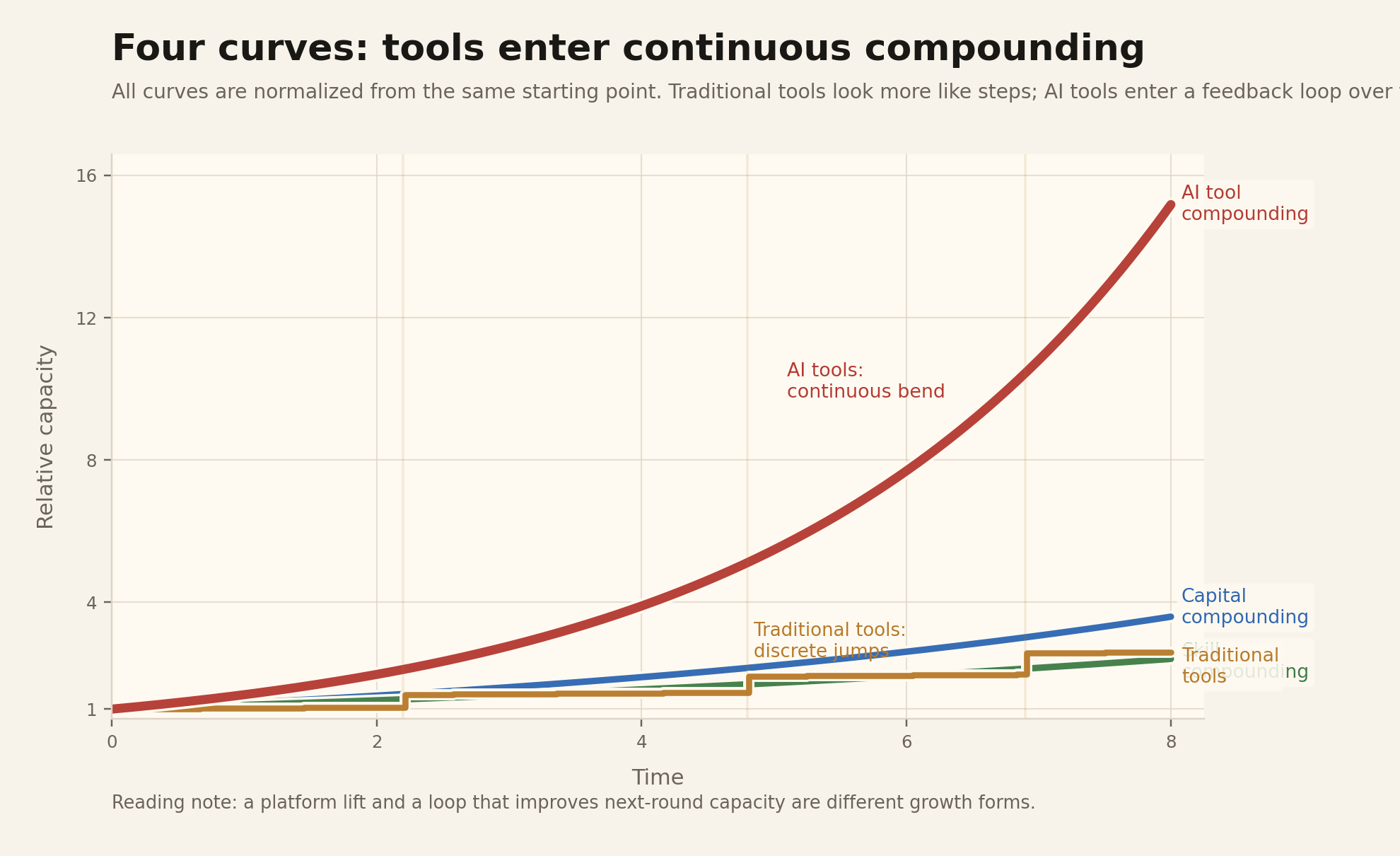
This is the difference between a step change and continuous compounding. A step change asks how much efficiency rose when the tool appeared. Continuous compounding asks whether the next round of capacity improves because the tool was used in the previous round. The former can be dramatic. The latter is what makes a curve keep bending upward. Traditional tools were often strongest at the moment they entered the system. After that, further growth came from human fluency, process redesign, organizational adoption, and the next external generation of tools.
This also explains the disappointment of many digital transformations. A company implements a new system and efficiency initially improves. Processes move online, information is centralized, approvals become traceable. But over time the system may become another burden: more fields, heavier procedures, outdated documents, and extra work created to satisfy the system. The tool moved the old process online, but did not keep absorbing the organization's real experience or correct the next round of work. It still has value, but the value remains a platform lift. Without a feedback mechanism, the platform does not keep bending upward.
Understanding this avoids two extremes. One extreme is to underestimate traditional tools, as if only AI matters and earlier tools were simple instruments. That is wrong. Without the long accumulation of traditional tools, there would be no modern productivity and no workflow for AI to enter. The other extreme is to call every efficiency gain compounding. If a tool raises output once, people call it compound growth. That dissolves the concept. Efficiency gains can be one-off, linear, or stepwise. Compounding only begins when the result of this round improves the capacity of the next.
Traditional tools should therefore be placed accurately: they are a gigantic force in the history of growth, but usually not an independent continuous compounding curve. They are a series of important steps that lifted individuals, organizations, and societies to higher platforms. The curves that kept bending upward were mainly capital and skill. AI becomes interesting only against this background. If AI is just a faster tool, it remains another step. If it only accelerates tasks without retaining use experience, entering feedback loops, or changing next-round capacity, then even a very strong AI is still a tool upgrade. But if it can absorb context, reuse historical examples, connect to knowledge bases and workflows, and turn human judgment into callable templates, rules, agents, and evaluation systems, then tools begin to approach continuous compounding.