Closing / 6 parts
A Cloud, Not the End
Economics does not end here. Some of its default assumptions need to be priced again.
Closing
After Division of Labor: Closing
A Cloud, Not the End
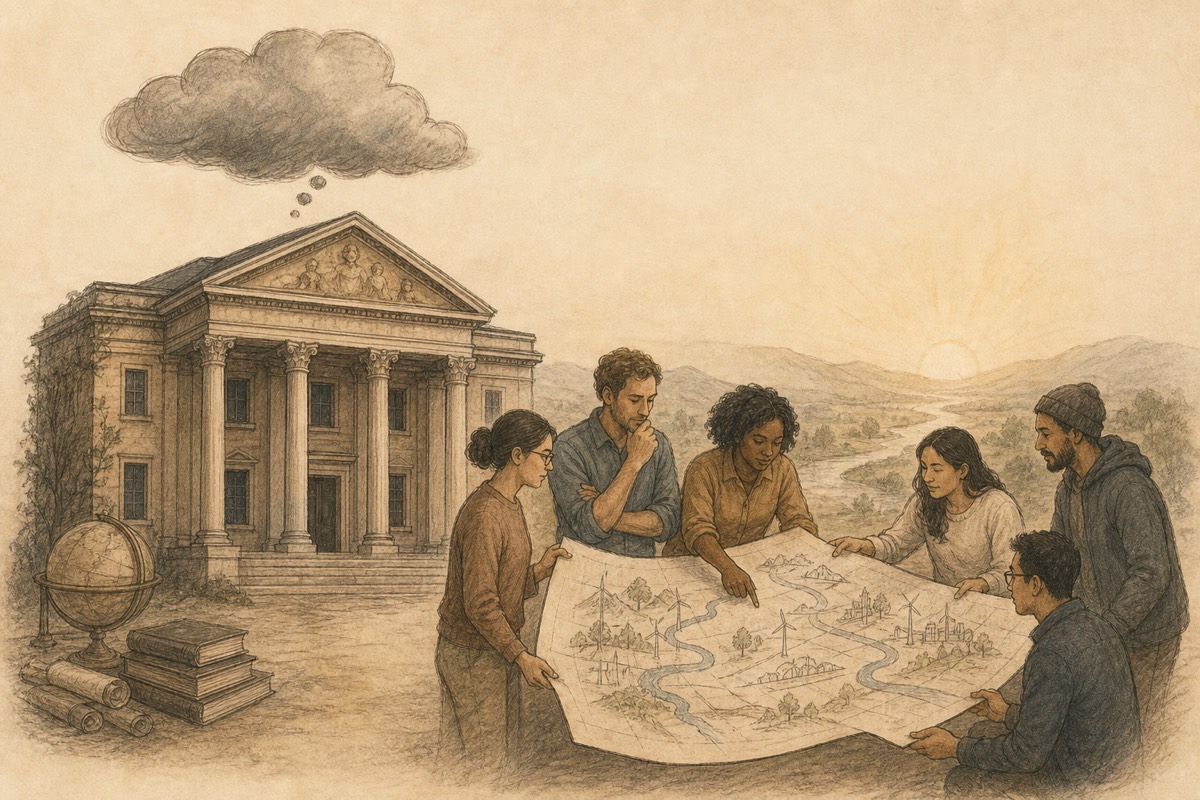
The argument of this essay can be compressed into one sentence: old economics did not suddenly become wrong; part of the productivity condition behind it is changing.
This is why the essay began by defending the old theory. Division of labor was not a mistaken answer. It was one of the best answers for a world where the single action unit was weak and execution was expensive.
It helped build large-scale production, complex exchange, firm organization, and modern growth. Because it was so correct, we have to take seriously what changes when its supporting conditions change.
The “cloud” in this essay has that meaning. It does not announce the collapse of modern economics. It does not predict that firms, markets, institutions, and specialization will disappear in the short run.
The issue is narrower and deeper: if agent systems expand the capability boundary of the action unit, lower execution costs, and allow fewer people with stronger tools to carry longer chains of work, then old organizational intuitions around deep specialization can no longer be assumed without qualification.
The cloud is not above the surface formulas. It is closer to the default assumptions. We assumed that finer task division means higher efficiency, clearer roles mean stabler cooperation, and longer management chains mean more control.
Now each of those assumptions needs a condition attached: under the new productivity regime, does it still hold?
If the question is serious, then the future task is larger than adding agent tools to old workflows. Three deeper questions have to return.
First, economics needs to redefine the minimum effective action unit. In the past, that unit was usually a worker plus role training. In the future, it is increasingly human + agent + tools + workflow.
Second, economics needs to ask which tasks should be split and which should remain in a loop. The old question was often “how do we split this so it can be done?” The new question becomes “does splitting this make it slower, more fragmented, and more likely to lose intent?”
Third, economics needs to rethink why organizations exist. Firms, platforms, markets, and institutions remain, but each must answer what function it serves under new productivity conditions. Who preserves context? Who takes risk? Who owns capital? Who builds trust? Who is responsible for the complete result?
This essay does not try to present a complete new economics. It only tries to put the question in the right place.
For more than two centuries, division of labor was a remarkably successful answer. Today, it faces a new question across more and more settings: once stronger action units exist, is cutting tasks into ever smaller pieces still the best organizational principle?
If the answer is no, economics is not ending. It is entering another generative moment. New productive forces are approaching. New production relations will not be absent forever. New organizational forms are being explored. New questions will need names.
The point of a cloud is not to declare that the sky has fallen. It tells us the pressure has changed.