Chapter 2 / 6 parts
Gains and Friction Costs
Division of labor never produced pure gains. It also created coordination costs that were easy to ignore when the gains were large enough.
Chapter 2
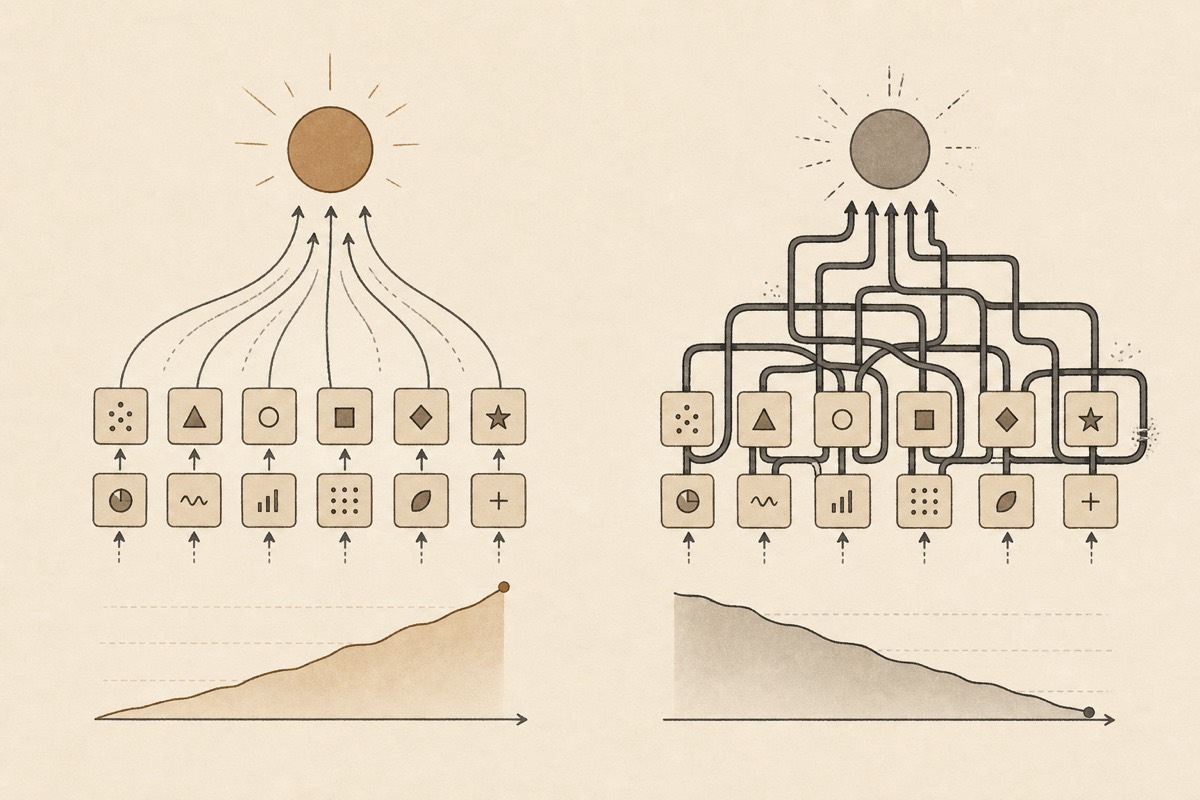
After Division of Labor: Chapter 2
Gains and Friction Costs
The first chapter defended division of labor. This chapter adds the missing half: division of labor has never been a pure gain mechanism.
Every time a task is split, the system must pay to reconnect it. The more specialized each link becomes, the more important the interfaces become. A divided system has to communicate, align, supervise, verify, and assign responsibility.
These costs did not appear only in the Agent era. They have always existed. The reason they often stayed in the background was that the gains from specialization were enormous. When the gains are large enough, friction can be absorbed.
1. Division of labor moves complexity to the interfaces
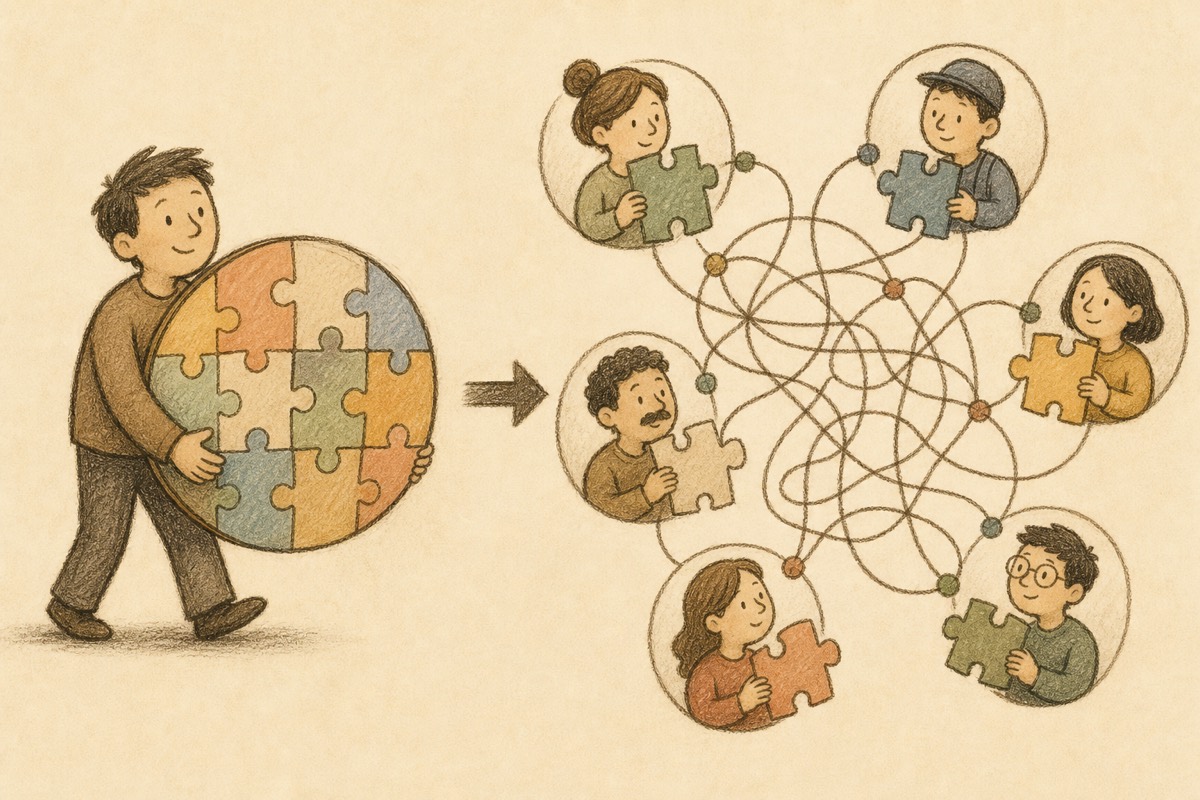
When we split a complex task, we reduce the complexity inside each role. But the system does not delete that complexity. It moves a large part of it to the boundaries between roles.
Each person now needs to know what comes in, what goes out, who depends on the result, what standard counts as acceptable, and what happens when something changes. The work inside a link may be simpler, but the work between links becomes heavier.
This is the basic tradeoff of division of labor: it simplifies local execution by increasing the need for coordination.
2. The main friction costs
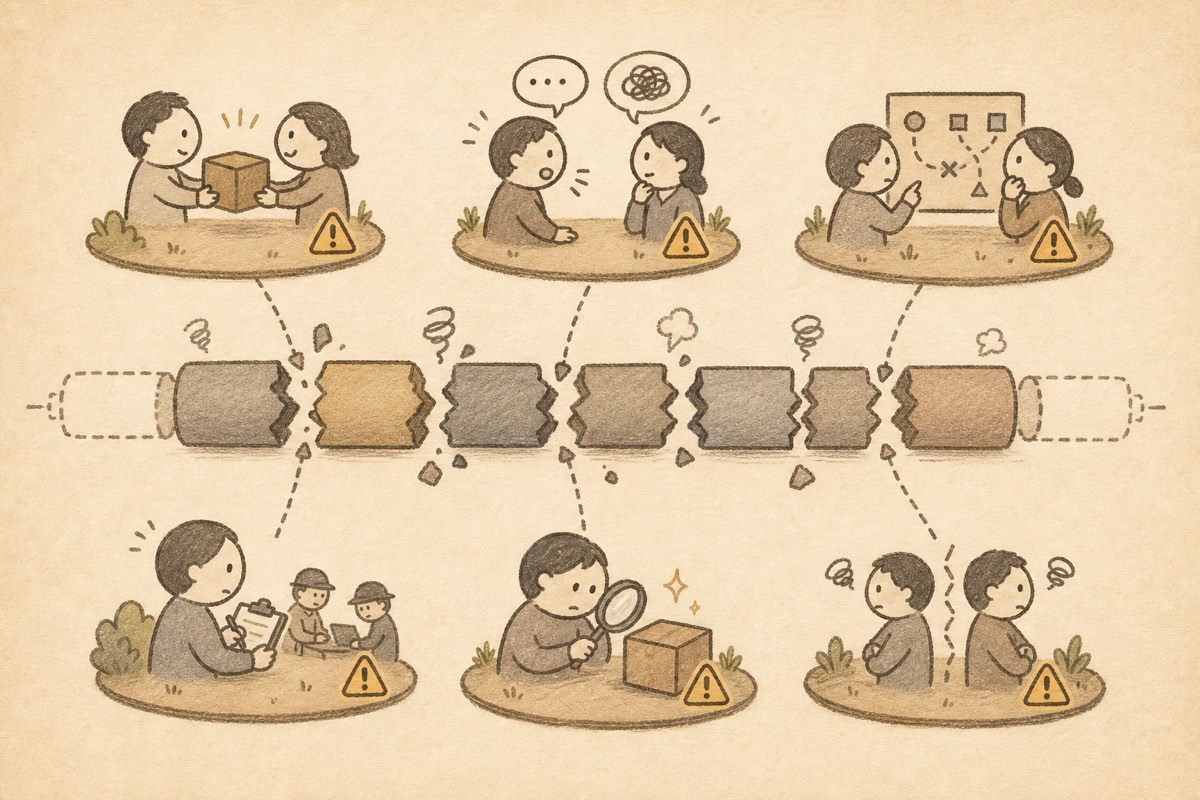
The first cost is handoff. When a task moves from one person to another, context has to be compressed, passed on, and reconstructed. Each handoff risks delay, misunderstanding, or loss of intention.
The second cost is communication. In a divided system, each person holds only local knowledge. Designers explain intent to engineers, engineers explain constraints to testers, testers explain risks to product people, and managers translate across all sides.
The third cost is alignment. People do not naturally share the same definition of the goal, the same sense of priority, or the same tolerance for risk. Alignment consumes time because divided work creates divided viewpoints.
The fourth cost is supervision. Once work is split, someone has to check whether each part is moving, whether each link is on standard, and whether the pieces still add up to the original goal.
The fifth cost is verification. A partial output may look complete inside one role but fail when placed inside the larger system. The system needs extra effort to test whether the pieces fit.
The sixth cost is responsibility splitting. When many people each own a narrow slice, it becomes harder to know who is responsible for the whole result. Local accountability can coexist with global ambiguity.
3. Firms and institutions already prove that friction exists
If division of labor created only gains, many modern organizational forms would be unnecessary.
Firms exist partly because divided production needs continuous coordination. Markets can connect specialized producers, but they cannot always handle frequent, detailed, rapidly changing collaboration at low cost. Firms internalize some of that coordination through command, process, and hierarchy.
Institutions exist for the same reason. Contracts, standards, procedures, interface rules, quality requirements, reporting mechanisms, and review systems look like management overhead. In practice, they are ways to reduce uncertainty created by divided work.
Many management roles also make more sense from this angle. They often exist to stitch, check, coordinate, arbitrate, and reallocate. A system with deeper specialization tends to require more intermediate roles to keep the parts connected.
4. Why friction did not dominate in the past
The answer is straightforward: the gains from division of labor used to be enormous.
In a world where the individual action unit was weak and execution was expensive, specialization delivered large improvements in speed, skill, tool fit, and quality control. The coordination costs were real, but the net gain was still attractive.
Many tasks in the past were also repetitive, stable, and clearly bounded. Factories, standardized services, and fixed office processes could absorb friction through procedure. When the environment changed slowly, coordination costs could be spread over long periods of operation.
Organizations also tolerated management cost because direct production capability was expensive. As long as the specialization machine produced enough value, it could support layers of administration, supervision, and mediation.
5. Friction can compound
Friction costs do not always grow linearly. One handoff between two people may be cheap. A task that moves through several roles, approval layers, systems, and organizations creates a different problem.
Each added link is not merely one more person. It is one more interface, one more wait, one more explanation, one more chance for misunderstanding. In large systems, the main energy drain is often not slow local execution but small delays across the chain.
This is why large organizations can be full of skilled people and still feel slow. The problem may not be that any local role is lazy or incapable. The problem may be that the chain has too many interfaces.
6. Conclusion: division of labor is never pure gain
Division of labor raises skill, stabilizes process, and increases scale. At the same time, it creates handoff, communication, alignment, supervision, verification, and responsibility costs.
Coordination is not an external problem added later. It is the organizational result of pushing division of labor deeper.
In the old productivity regime, specialization gains were large enough to keep these costs in the background. Once productivity changes the gain structure, we have to ask a sharper question: under new conditions, is the net gain from division of labor still large enough?